Failure body after Horn
We calculate with the sliding wedge and prism model up to the ground surface, with silo effect from 2D and an iterated slip angle – as described in the DAUB recommendation.

Face support pressure calculation for shield and pipe-jacking drives – by the engineers of BabEng
The engineers of BabEng determine the required and the permissible support pressure at the tunnel face according to the DAUB recommendation (2016) and ZTV-ING – with our calculator FaceSupport. You receive a report with ground section, sliding wedge and all verifications.
Request a calculation Learn more
Enquiries to contact@babeng.com. Employees of BabEng and Tunnelsoft open the calculator via “Launch”.
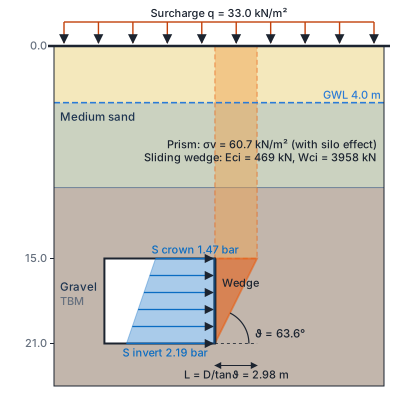
We calculate with the sliding wedge and prism model up to the ground surface, with silo effect from 2D and an iterated slip angle – as described in the DAUB recommendation.
Normal advance as well as one-third, half and full lowering for personnel entry, each with local ordinate checks and control tolerance.
We check the maximum permissible support pressure against the required one. If cover is insufficient, we propose ballast loading.
For slurry drives: required yield strength of the support slurry from micro-stability and pressure gradient.
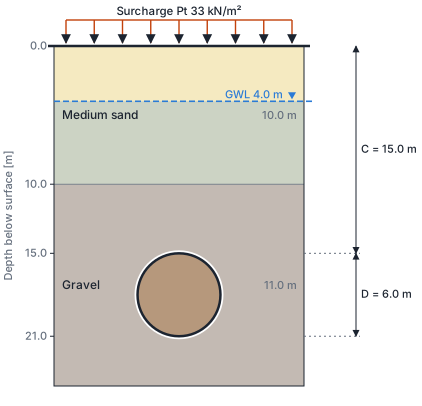
Layers, groundwater, surcharges and the geology at the face in a true-to-scale section – not just tables.
Results, input data, graphics and calculation basis in one report with project, client and author details.
Every calculation is stored per project with version, author and time – changes stay traceable.
The engineers who carried out the work answer questions on assumptions, results and report.
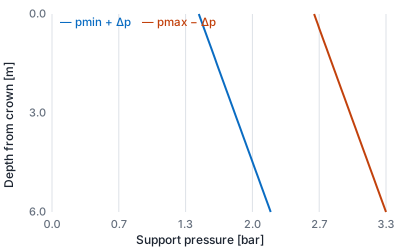
For each operating mode we state the minimum and maximum support pressure and a recommendation – rounded to the machine's setting precision (0.1 bar), on the safe side.
| Operating mode | pmin [bar] | pmax [bar] | recommended [bar] |
|---|---|---|---|
| Normal advance | 1.5 | 2.6 | 1.7 |
| One-third lowering | 1.7 | 2.6 | 1.9 |
| Half lowering | 1.8 | 2.6 | 2.0 |
| Full lowering | 1.9 | 2.6 | 2.1 |
Example: DN 6000, slurry, 15 m cover, sand and gravel, groundwater 4 m below surface, traffic load 33 kN/m².
You send us the project, the ground investigation report and the machine data (diameter, cover, groundwater, surcharges).
Our engineers model the ground in the calculator, calculate all operating modes and assess the results.
You receive the report as PDF with support pressures, verifications and graphics – including the assumptions to be confirmed by your geotechnical engineer.
The assumptions made must be confirmed by the client's geotechnical engineer. FaceSupport does not replace a checked structural analysis.
Write to us at contact@babeng.com. The calculation is carried out by the engineers of BabEng using the FaceSupport calculator.
Employees of BabEng and Tunnelsoft open the calculator via “Launch” at the top right (sign-in with the Microsoft account).